> I quit social media many years ago and to answer the question: No, I just watch Youtube. If I could stop watching Youtube, I'm totally sure I'd finally be able to read books again /s
You /s, but when I quit the internet completely, I did become a voracious reader of books. I also spent hours practicing piano. And I went to bed on time.
Like you I also have diagnosed and untreated ADHD. But at this point it feels like it's a misdiagnosis and I'm simply incompatible with the internet.
You'll probably think that I'm sort of maniac or that I'm messing with you but honestly, I feel like I'm part of the internet. I mean it. I'd probably feel like a screw that fell of a large ship. The ship is unaffected, while I'd be collecting rust at the bottom of the ocean.
My jokes sound like reddit. I give HN reactions to new startup ideas. I review code like I'm in front of a large crowd from GitHub. I make meme references. I don't play games, I watch other people play -> less stress.
On the other hand, I want to read books! I want to practice the piano! (See, I bought this nice YAMAHA keyboard that's collecting dust).
This is a very strong, explicit statement in response to someone using the term rather casually. Can you explain why you are so sure?
I do think you need to define 'comprehension' in order to be certain. A statement fitting the form of "it doesn't comprehend, it just X" is incomplete, because it fails to explain why X is not a valid instance of comprehension.
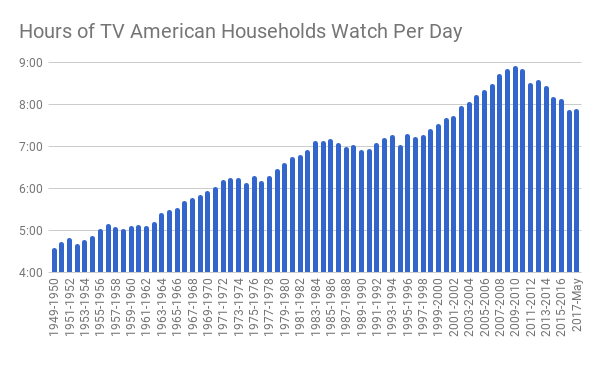
TV use was higher in the 2000s than it was in the 1980s/1990s. TV viewing hours steadily rose from 1949 until finally peaking in 2010.[1]
But when TV finally peaked in 2010, did overall screen time go down? No. It kept going up.[2] Obviously, this is when the masses went all-in on smartphones, social media, and the internet.
Screen usage basically never went down. It has only gone up.
So I only see anyone getting tired of smartphones and actually using them less if they've found something more addictive to replace them.
You have a good point I overlooked, thanks for the correction. I actually missed the "TV was just displaced" angle, which makes sense both statistically and anecdotally, if I think about family and friends.
TV also had a social aspect that internet does not have by construction: You had the same program on only a few TV channels and this was funneling people to talk about similar things or have discussions about the previous day show.
These things rarely happen organically anymore unless "forced" in one way or the other...
> I was surprised because I always considered them to be the worst physical medium for music.
That's a big part of why they're cool.
Imperfection is beautiful. We feel this intuitively when it comes to loving someone, or when it comes to impressionistic art. It really is the same thing with music.
I believe the typical response is that you can simulate that imperfection on digital media... but cassette lovers would argue this is tantamount to putting a photograph through a 'Da Vinci' filter in Photoshop. It's missing the point. There's more to music than what it sounds like. Where it came from, what you did to play it, these are all part of the experience. The context of a piece of a media, the means by which you listen to it, where it came from -- these change how the music feels, even if there is no difference in how it sounds.
Back when vinyl or cassettes were the only option, sure, the response is "screw your romanticism". But now that we have perfect digital media always available, there is romance in getting to choose something fragile and imperfect and precious. People like that feeling.
What you're saying is a very common "poptimist" trope of the last decade or two. To say that, actually, these vocalists are highly intelligent and largely responsible for their own success.
Charli XCX, like nearly all popstars, was propped up by the producers and writers who shaped her sound and composed large parts of the music. Producers have been there the whole way. In particular, her blowing up was highly influenced by the stylistic direction, composition, production and sound engineering of people associated with the PC Music record label. The statement that she had good enough taste to have been around these people is rather unfair -- she was around artistic innovators like Sophie, yes, but THEY are the ones that pioneered the sound.
The most common refrain is that popstars often write their music. This is misleading: they write the lyrics, suggest a general vibe, and some rough melodies or chords. And even this is a stretch many times. They are not composing or producing the music in any larger sense, and this is the pivotal part of actually making music.
One famous exception that comes to mind is Grimes, who largely actually /makes/ her own music. She rarely seems to get credit for this.
This is not to say that vocalist popstars don't bring a lot to the table. They do. But what they bring to the table is incredible performance skill and charisma. I think poptimism has gone too far, to the point that we think the product was responsible for creating itself.
> In particular, her blowing up was highly influenced by the stylistic direction, composition, production and sound engineering of people associated with the PC Music record label.
No, if anything Charli XCX was the one that put PC Music on the map. She has been a fairly big name since 2012
> she was around artistic innovators like Sophie, yes, but THEY are the ones that pioneered the sound.
Sophie didn’t pioneer the sound of PC Music any more than e.g. AG Cook, QT, Hannah Diamond, Danny L Harle, 100 gecs, or any of the other many artists involved, including Charli XCX
You’re talking as if PC Music is some huge label with a lot of help, when it’s mostly just AG Cook. He and Charli XCX collaborated on tracks for a couple of Charli’s albums
Charli XCX was around before PC Music, but the sound she is known for and became famous for originated from PC Music. The fact that she delivered a bit of "minor popstar" cred to them is fine, but the key to my point is that they determined the sound that made her iconic.
Sophie was an example. I didn't see it necessary to talk about all the artists involved in PC Music to make the point that the producers on the label pioneered the sound.
Look at the credits for her albums. She had producers and writers credited on every single song. This IS a lot of help. You're acting like she just did a couple of collabs with AG Cook and that's it. She had many different people helping her on the actual composition and production of every single song.
This is the point being refuted -- that the popstars are geniuses responsible for carrying the burden of their rise. It's mythology. The reality is that they bring performance skills and charisma to the table, some non-awful lyrical skill, and then the lion's share of actually making the music work is done by producers and writers. They would be nowhere without the producers. The producers would be nowhere without the popstars. But it's the most common poptimist mistake to confuse the popstar's charisma for the producer's mastery.
Your point is clear, but Charli does a lot of production on her albums, so I'm not sure she's the one to make this point about. She's not a once in a lifetime producing genius like Sophie, but she doesn't claim to be. Yung Lean did not produce the sound that made him famous either.
I think in the modern day, due to Internet, access to DAWs, etc, a lot of pop stars actually do/did much more of their own writing and production, see Billie & Finneas or Chappel Roan. It's just much more accessible, there's lots of pretty faces on social media so to really break out, you either need some real connections or real chops.
> The most common refrain is that popstars often write their music. This is misleading: they write the lyrics, suggest a general vibe, and some rough melodies or chords. And even this is a stretch many times. They are not composing or producing the music in any larger sense, and this is the pivotal part of actually making music.
To be fair, if they write the lyrics, define the vibe/feel of the song, and compose the melody and chord progression, then that does sound like the vast majority of the song. What's left - I guess some additional instrumentation, the percussion, production? To me it does sound fair to credit the popstar with having composed the music in this case.
The operative word was "rough". They give a few hints; they're not painstakingly mapping out the melodies and chords for every instrument and determining what those instruments are, and how they sound.
If you're writing for a guitar and voice, then you've basically got a song, but pop music is built on sometimes hundreds of different instruments and effects.
That seems like quite a high bar, to the extent that I'm not sure we could ever credit anyone with creating a pop song if it applies. Everyone seems comfortable crediting Lennon and McCartney with their various Beatles songs, for example, but were they doing all the things you describe? Did they do more to create those songs than, say, Taylor Swift does for hers? It's not obvious to me that it's the case.
Yes, they did. George Martin was an arranger, not a co-writer. Max Martin is a co-writer.
If you gave Lennon and McCartney a couple of guitars, a few days of studio time, a good mood, and no other help you'd probably get a hit. Or at least an interesting song.
If you gave Taylor Swift the same you'd get a demo, maybe. You might get an unassisted hit, but the odds are much lower.
Charli XCX - even more so. Give her a laptop and microphone and some plugins and no producer, and I doubt you'd get much.
Not to say that what she and Dua Lipa do is easy. But they're fundamentally performers and brands for a music production operation.
Creative agency isn't a binary. It's on a spectrum. Some people have very little. Some have a lot. Some have taste that defines the product, even though they're mostly curating other people's work.
Michael Jackson was notorious for this. He was a phenomenal dancer, an ok vocalist, not much of a practical musician. But he had a strong sense of what he wanted, and he had a theatricality that pulled the whole thing together.
Charli XCX is a version of that. I don't think her appeal is as strong or as universal, and I doubt she has as much agency as Jackson did. But it's the same idea - shape, curate, perform.
Yes, it's absolutely the case for Lennon and McCartney, since they didn't give rough ideas to George Martin to fill in; they specifically wrote the exact melodies for half the instruments involved and exactly how to play them.
You could argue that Harrison and Starr always deserved some of the writing credit, since they often determined their parts, and I wouldn't actually disagree with that -- though Lennon and McCartney were kinda control freaks, so I'm not sure how much leeway was actually given. When they started bringing in extra instruments, again, there is arguably some extra credit to be given to Martin and others, but Lennon and McCartney were still strongly directing what was to be played.
For what it's worth -- and this is going to get me hated even more than my popstar-skepticism -- I don't really like the Beatles that much. But it's transparent that they did more than Taylor Swift because they were specifically and precisely writing the melodies for the instruments being played.
I'm personally a little frustrated with these music theory answers. Trust me folks, these answers are nearly impossible for a non-musician to understand (and even as a musician it's a bit impenetrable).
E minor gives you the exact same amount of options as C major. The options are just shuffled around a little bit. You literally get the same amount of notes in either, just a slightly different set. It isn't any more complex. Listeners aren't going to notice a difference, except one will probably sound happy and one will probably sound sad/angry. The "acceptance volume", to use the blog author's term, isn't any different.
At best, it can change things a little bit for some instruments. For example, with a vocalist, their voice can only go so high. They might be able to hit up to a high C, but not even higher up to an high E. If you're in C major, that's great, the vocalist's highest note (C) is the 'home note' which sounds great (playing a C in C Major makes the song sound like it's 'finished'). If you're E minor, the 'home note' is E, and as mentioned they wouldn't be able to hit that note. So you wouldn't really be able to 'finish' on a high note.
Ultimately, I doubt the author is a musician. It was a strange example to make their point.
> Chatbots [are] going to remain niche for quite some time.
> iPhone immediately caught on like wild fire.
> I'm not saying there won't be users, but it's a much smaller population.
The facts say you're wrong about this.
The adoption rate for the iPhone was slow. There were only 1.4 million iPhones sold in its first year,[1] whereas there were 100 million weekly active ChatGPT users in its first year.[2]
ChatGPT is not niche, and is not a 'much smaller population'. Right now it has 800 million weekly active users. That's how many iPhones were active in 2017. Are we to say that iPhones were a niche in 2017? It's how many smartphones in general were active at the start of 2012. Are we to say that smartphones were a niche in 2012?
> The adoption rate for the iPhone was slow. There were only 1.4 million iPhones sold in its first year,[1] whereas there were 100 million weekly active ChatGPT users in its first year.[2]
The ChatGPT number includes people who paid no money. iPhone adoption was incredibly fast for a paid product
It's my fault for lumping tools like ChatGPT into the bin of "chatbots" that people - mostly kids - are sexting and forming intimate relationships with. In my mind, the latter are "chat" apps.
ChatGPT and Claude have incredible utility, whereas Character.ai-type chatbots are much less certain. I can't fathom trying to spend more than a few minutes talking to them since they have so many shortcomings.
I don't consider ChatGPT a chatbot because my inquiries tend to match my usage of Google Search. It's a search tool.
Putting on a headset for the first time reminded me of using a computer for the first time. It was that paradigm-shifting.
The frustrating thing is, back when computers were "silly" and "not ready", the type of person you'd now find on Hacker News saw it as an exciting impetus to build a new world. With virtual reality, all I see is a collective eyeroll. It's honestly tragic. This is a burgeoning medium, a new form of art. For most of human history, people didn't get to experience that even once in their entire lifetime. And the response is cynicism.
The only explanation I have is that we are so inundated with stimulus, so overwhelmed with entertainment, that we no longer feel a drive to build a new form of it. We're all drugged up on social media, and can't see the potential of a new medium even when it's literally right in front of our faces.
I do personally believe that Charlie Kirk has done some damage to societal perceptions of transgender people.
With that said, the person asked how Charlie's quote could stoke violence, and then you invented a significantly stronger, more inciteful quote (something Charlie didn't say) as an answer for why it stoked violence.
This is not a response that will convince people of your position. I'm not sure on the best way to do that, but I believe it starts by staying clear about what was actually said.
>some damage to societal perceptions of transgender people
Weird, how do we call people who do "some damage to societal perceptions" of black people? Of Jewish people?
Why are you reaching for such a tortured expression, "some damage to societal perceptions of [some] people"? Isn't there already some other word for that?
"Transphobia" is not the same as "damaging societal perceptions of transgender people". My colleague is transphobic. He hasn't damaged societal perceptions of transgender people, because he doesn't have a massive platform. Charlie Kirk, who I agree is transphobic, went one step further and actually impacted large groups of people's beliefs.
Your assumption that I was minimizing the damage he did with my wording is the opposite of correct; I was using that wording to express that the damage he did was worse than simply being transphobic.
But if we take 5 minutes to search, we can see Charlie Kirk has said publicly (and I quote):
"There's a direct connection to inflation and the trans issue. You say, Charlie, come on. They couldn't be further apart. No, they're exactly the same. They're the same in this aspect—when you believe that men can become women, why wouldn't you also believe that you could print wealth?"
(You are poor? Blame the trans)
"The transgender movement actually matters even more than biomedical fascism"
"the transgender movement is an introductory phase to get you to strip yourself of your humanity to mesh with machines"
"if you stop being a man, then maybe you can stop being a human being"
(Transhumanist scare you? Blame the trans - those non-human beings)
Maybe you think I exaggerate? Luckily, he has made his personal opinion clear:
"I blame the decline of American men. This never should've been -- someone should've just took care of it the way we used to take care of things in the 1950s or 60s"
Tell me, how did things were taken "care of" in the 50s and 60s? What could that be a reference to? (Wink wink)
Not convincing enough? Last direct quote from him:
“The one issue that I think is so against our senses, so against the natural law, and dare I say, a throbbing middle finger to god, is the transgender thing happening in America right now”
Really, who could think that when he said there are too many (how many? Doesn't matter, just believe it) mass shootings caused by trans people, he is inviting fear and hatred against them? Really, it would be dishonest to suggest such a thing, right?
He was also openly racist and homophobic, but hey, how could I or anyone suggest he was stroking violence and stirring hate?
> What evidence can you point to that supports this "most likely" assertion that isn't purely naturalistic fallacy?
Reducing this to the naturalistic fallacy is inappropriate.
Notice the commenter said "most likely". He's using a heuristic. When we are working with incomplete knowledge (e.g. lack of studies on phenoxyethanol), naturalism is a useful probabilistic heuristic because we are /generally/ adapted to what was in our ancestral environment. It's also a useful heuristic to defer to things we have a significant amount of understanding of (olive oil) than things we have little understanding of (a concoction invented in the 2010s).
When we say "natural", by the way, we are approximately referring to what humans adapted to by natural selection. Eating large amounts of cyanide isn't "natural" just because it's in nature; that's semantic confusion.
No one objects to saying a zoo animal should be eating its "natural" diet, and that its enclosure should represent its "natural" habitat, because this is a generally true useful heuristic. Maybe the apes are going to be healthier if you put them in a VR headset with Half-Life: Alyx and feed them protein shakes -- where's the research? -- but I'm not going to put that on equal footing until the research is out. Until then, I'll go with naturalism.
There are artificial things that are very good for us, such as vaccines. But we know this because we have sufficient research. When we don't have sufficient research, heuristics like naturalism are going to give you better results on average.
>The pantheon of capricious gods living on mount olympus? Harvesting the sweat of wrestlers to use as treatment for genital warts?
He said they got "some" things right. It's implied that they got a lot of other things wrong.
> Reducing this to the naturalistic fallacy is inappropriate.
> Notice the commenter said "most likely". He's using a heuristic.
They are using a purely appeal-to-nature-and-antiquity-without-any-other-justification heuristic. If your objection is that I should have said "appeal to nature and antiquity without any other justification" because you think "naturalistic fallacy" means something else (which it might), then ok let's go with that, but otherwise it's very appropriate.
"Most" likely is a decision about the balance of merit.
Show something beyond "people did it without chemical analysis" that doing one is actually better than doing the other, especially in the way being discussed by the article. Show that rubbing olive oil on your body won't likewise disrupt your oxidation field. Show that the polycyclic aromatic hydrocarbons in olive oil aren't individually disruptive to skin chemistry despite suspected or known links to cancers, cardiovascular disease, and poor fetal development.
> He said they got "some" things right. It's implied that they got a lot of other things wrong.
Picking which things were right and which ones were wrong requires analysis of the merits. They did none of that.
ps. Do we have a reason to call them "he"? I didn't see anything in their profile or comment history.


You /s, but when I quit the internet completely, I did become a voracious reader of books. I also spent hours practicing piano. And I went to bed on time.
Like you I also have diagnosed and untreated ADHD. But at this point it feels like it's a misdiagnosis and I'm simply incompatible with the internet.
reply