I agree that reality is complex, but I worry you are conflating the challenges of running an Amazon-scale business with running the smaller businesses that most of the entrepreneurs on HN will need to manage. I thought Roger offered a more practical approach in about 10% of the words that you took. I am sorry if I have offended you; I was trying to save the entrepreneurs on HN time.
As to Jack Stack's book, I think the genius of his approach is communicating simple decision rules to the folks on the front line instead of trying to establish a complex model at the executive level that can become more removed from day-to-day realities. In my experience, which involves working in a variety of roles in startups and multi-billion dollar businesses over the better part of five decades, simple rules updated based on your best judgment risk "extinction by instinct" but outperform the "analysis paralysis" that comes from trying to develop overly complex models.
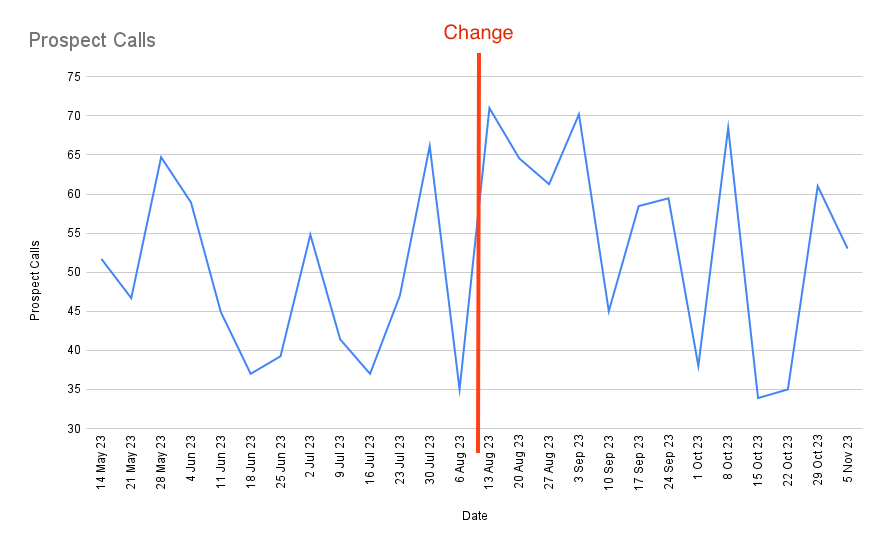
How do you answer? Notice that this is a problem regardless of whether you are a big company or a small company.
b) 3 months later, your client comes back and asks: “we are having trouble with customer support. How do we know that it’s not related to this change we made?” With your superior experience working with hundreds of startups, you are able to tell them if it is or isn’t after some investigation. Your client asks you: “how can we do that for ourselves without calling on you every time we see something weird?”
How do you answer?
(My answers are in the WBR essay and the essay that comes immediately before that, natch)
It is a common excuse to wave away these ideas with “oh, these are big company solutions, not applicable to small businesses.” But a) I have applied these ideas to my own small business and doubled revenue; also b) in 1992 Donald Wheeler applied these methods to a small Japanese night club and then wrote a whole book about the results: https://www.amazon.sg/Spc-Esquire-Club-Donald-Wheeler/dp/094...
Wheeler wanted to prove, (and I wanted to verify), that ‘tools to understand how your business ACTUALLY works’ are uniformly applicable regardless of company size.
If anyone reading this is interested in being able to answer confidently to both questions, I recommend reading my essays to start with (there’s enough in front of the paywall to be useful) and then jump straight to Wheeler. I recommend Understanding Variation, which was originally developed as a 1993 presentation to managers at DuPont (which means it is light on statistics).


As to Jack Stack's book, I think the genius of his approach is communicating simple decision rules to the folks on the front line instead of trying to establish a complex model at the executive level that can become more removed from day-to-day realities. In my experience, which involves working in a variety of roles in startups and multi-billion dollar businesses over the better part of five decades, simple rules updated based on your best judgment risk "extinction by instinct" but outperform the "analysis paralysis" that comes from trying to develop overly complex models.
Reasonable men may differ.